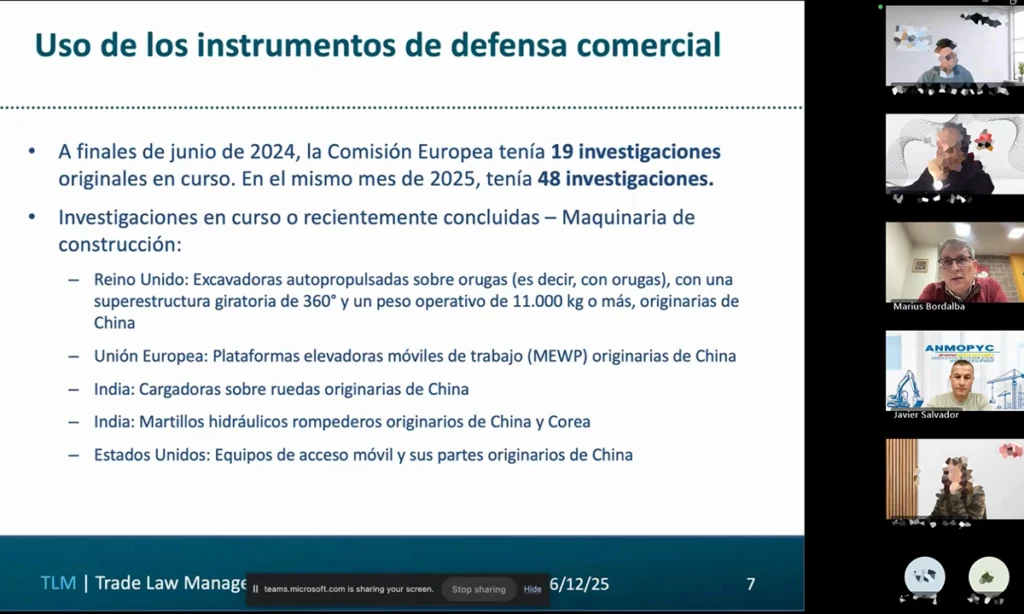

On December 16, ANMOPYC held a webinar in collaboration with Trade Law Management (TLM) to address a topic of growing relevance: the use of trade defense instruments in the European Union in the face of a significant increase in imports in strategic industrial sectors.
The session was led by Marius Bordalba, an expert consultant in European law and international trade with more than 25 years of experience in Brussels, the WTO and advising governments and companies. Bordalba gave a practical overview of the mechanisms that the EU makes available to industries to protect their competitiveness:
- Antidumping measures, applied when imports are made at prices below the normal value.
- Anti-subsidy measures, to counteract state aid granted by third countries.
- Safeguards, which are applied exceptionally to all imports of a product when there is a massive increase causing serious injury.
The speaker underlined the historical increase in the use of these instrumentsThe European Commission's investigation into the European Union's imports of machinery and equipment has increased from 19 investigations in June 2024 to 48 in June 2025, reflecting the sharp rise in imports, especially from China, India and Turkey. This phenomenon is putting increasing pressure on the European industry, with recent cases in the sector of machinery such as lifting platforms, crawler shoes and mobile cranes.
During the webinar, the following were detailed requirements to initiate a complaint, among them:
- Represent at least 25% of European production of the affected product.
- Provide evidence of dumping or subsidization and demonstrate the damage to the European industry through indicators such as sales, prices, profitability, employment and investments.
- Justify the causal relationship between the unfair practices and the damage suffered, as well as to assess the interest of the European Union in the adoption of measures.
The procedure before the European Commission, Bordalba explained, may extend to 14 months, with provisional measures after 7 months. The definitive measures are in effect for an initial period of 5 years, extendable. The anti-dumping measures imposed on China are generally exceeding 30% (this ad valorem percentage must be paid in addition to the applicable import tariff). Trade defense instruments have proven to be effective in curbing unfair competition and restoring stability to affected companies.
The expert also addressed strategic aspects such as the right time to file a complaint, the importance of sectorial representativeness and the costs associated with the process, which may vary depending on the type of advice.
In addition, the need to monitor import and price trends to anticipate risks and act quickly.
You can find attached the presentation developed by the speaker during the day. If you have any questions, please contact the expert directly: marius.bordalba@tradelawmanagement.com.
We remind you that TLM offers a first free consultation for ANMOPYC members.
Documents: