The
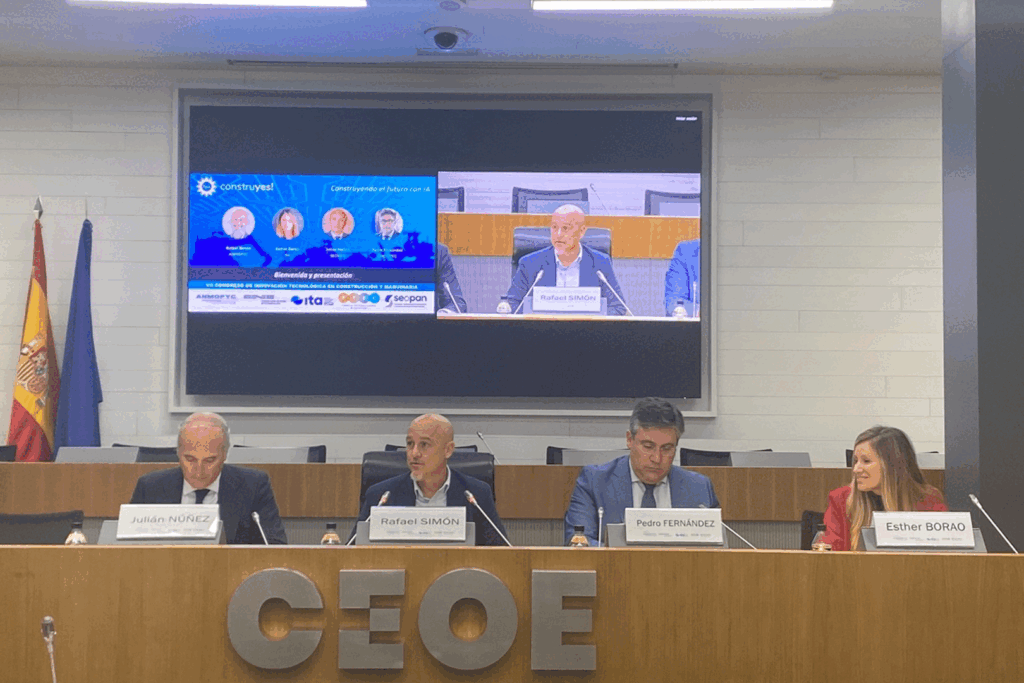
November 19, 2024, the CEOE hosted the seventh annual meeting of the
edition of construyes!, the Congress on Technological Innovation in Construction and
Machinery organized by ANMOPYC, CNC, ITA, PTEC and SEOPAN. The congress, which has
more than 200 attendees, including those who attended in person and those who attended in person.
those who attended via streaming, it was a window into the trends
that are shaping the future of the industry, dedicated to interested professionals
in new technologies that seek a meeting point for discussion, debate, and the
information and knowledge.
At
the seventh edition of this congress under the slogan «Building the Future
with AI» has explored the opportunities that Artificial Intelligence can bring to the
is generating in the construction and machinery industry, allowing the
efficiency, productivity and sustainability. We have also sought to
to present the current and future challenges involved in the implementation of this new
technology.
During
At the opening of the conference Rafael Simón, the new president of ANMOPYC, thanked in his speech all the speakers and participants for their attendance.
wanted to focus on the transformation that the sector needs to undergo in order to
“embrace change and lead the way to a more efficient future,
sustainable and innovative”, taking into account that one of the technologies called "sustainable and innovative" is the
The key player in this change is Artificial Intelligence.
A
Esther Borao, general director of ITA, then highlighted the value of the congress.
as a benchmark for innovation in the construction and construction industry.
machinery and urged attendees to “look not only at the present but also at the future.
but also to take into account what is coming in the future, in order to
to be able to explore and exploit our achievements and thus boost the sector”.
Julian
Núñez, president of SEOPAN, spoke about innovation as the tool
to be able to provide solutions to the challenges that society demands from the sector.
and how the use of Artificial Intelligence is redefining standards such as
and sustainability, whether it be in the world of food production or in the
construction as well as at the industrial level.
Pedro
Fernandez, president of PTEC, wanted to highlight the imperative need that
has the construction of deepening the formation and attraction of the
new generations, through the promotion of the great opportunities and
strengths of the sector, to be able to carry out the much-needed changeover.
generational. Only in this way will we be able to continue modernizing and adapting our products and services.
to new emerging technologies already discovered or yet to be discovered.
discover.
At
the first round table entitled “Boosting AI in the
Construction: Strategies and Public Policy.” moderated by Carlos Martínez, Managing Director at PTEC and Quality Director,
Environment, Risk Prevention and Innovation at SEOPAN, analyzed the
strategy and public policies necessary to implement the implementation of the
artificial intelligence within the construction industry from the point of view of the
view of public administrations and agencies.
The
The round of presentations of this roundtable was opened by Paloma Calzas, head of the
department of Industrial Technologies at CDTI, where he highlighted the value of the
ecosystem of support from the national innovation agency, designed to accompany
companies in the implementation of innovation within their organizations: “We seek to help create the future of construction and other sectors.
to help drive our country's growth,” he explained.
A
Paloma García, Director of Standardization Programs and Groups, followed by a presentation by
of Interest in the Spanish Association of Standardization (UNE), presented what is the
The role of standardization in the digital and ecological transformation of the Spanish industrial fabric: “Technical standards are never the only way to achieve the digital and ecological transformation of the Spanish industrial fabric: "Technical standards are never the only way to achieve the digital transformation of the Spanish industrial fabric.
The final objective, they are a means that helps both the sectors and the
administration to meet their challenges,” he said. In his presentation
commented on how standardization can help in the implementation of Intelligence
Artificial within the construction and machinery sector: “Within the
The Digital Spain 2026 plan has assigned us some clear tasks and several of them have been
they go along with the Artificial Intelligence Strategy Promotion Plan.
”he said. Also mentioned were some of its lines of work, such as the following
reliable AI seals or the monitoring of European legislation: Data
Act, AI Act, Cybersecurity, Cyber Resilience, Product Digital Passport and
request for AI standards in the new Machinery Regulation, among others.
others.
For
to continue with the presentations, Antonio Serrano, Professor of Law, will
Mercantile. Coordinator of Digitalization, Innovation and Communication of the FCJP,
gave a geopolitical overview of how Artificial Intelligence is changing and
is going to change the world: “Three transitions are taking place in parallel: one
transition of power, an energy and ecological transition, and a transition of
an analog economy to a digital economy”. He also noted that “Europe
has to wake up. The era of naivety is over. We cannot
that we ”remain indifferent to these transitions" and that we have the need to
“to engage in a reflexive exercise of freedom: invest less in regulations
and more in training to educate our citizens and to make them aware of
reality”. On the legislative issue, he made his assessment on the recent
approved European Regulation on AI: “It is a complex horizontal instrument,
incomplete and becomes obsolete to a certain extent due to the rapid evolution that
have these technologies. As a conclusion, he commented that ”we have to improve this
AI regulation to avoid a digital divide in Europe”.
Then
Pedro Prado, head of the Technological Innovation Planning and Monitoring Department at
the Community of Madrid, presented the system of aid to innovation
technological solutions in force in the Community of Madrid and some success stories
in innovation projects such as the VALREC - Modelo de
circular economy in construction with innovative solutions for the
recovery of Construction and Demolition Waste (CDW), SOSTEVAL-TEC - Development of a
comprehensive system for assessing and certifying the sustainability of
civil works through digital twins,
sensors, AI and blockchain o COGNITIVE HOSPITAL - Development of a platform
for the integrated management of hospitals through technologies
advanced technologies such as AI, IoT, Big Data, augmented reality, Blockchain or 5G networks.
For
Francisco Campuzano, Head of the Planning Section, will conclude this round table,
Information Systems and Research Office. Housing Agency and
Rehabilitation in the Junta de Andalucía, presented
the innovation actions carried out by the Housing Agency and the
Rehabilitation of Andalusia (AVRA) and its projects with
Artificial Intelligence: nZEISHB -
public procurement of innovation that will make it possible to develop an expert system that will
will make it possible to design multi-family buildings with near-zero energy consumption,
ZEBAI - AI applied to the optimization of zero-emission building design
o COSMIC - AI and data for large-scale energy resource optimization
scale.
During
the inspirational presentation “Digitizing and
modernizing the construction business with AI”.”
by Inmaculada Granado, Field Sales Representative for Services and
Construction of Google Cloud Spain, Google services were presented.
Cloud and the security they bring to companies: «The
artificial intelligence in the cloud such as Google Cloud enables rapid adoption and
the use of highly scalable models and resources».», he said. During his presentation he
analyzed the power of Google's Artificial Intelligence solutions.
within the construction industry: “From continuous video analysis
it has been possible to draw up reports on the progress of the work, costs or prevention of
occupational hazards, among others,” he explained. Also
mentioned how to realize its
The implementation of the system within the companies of the sector, through the
concept of sovereign cloud and digital sovereignty: ”Google Cloud is the first
hyperscalar certified in the National Security Scheme in which you can
choose where your data is stored, depending on the needs of your business.”.
At
the table of “AI Strategies in the
Construction: Innovation from the Machinery to the Final Project”.” moderated by Mariano Sanz, secretary general of CNC, were presented.
strategies, success stories and failures of companies when it comes to the realization of
technological implementations within its services and production processes
offered.
Beginning
Pedro José Ayala, Director of R&D and Innovation, opened the round of presentations at this roundtable.
Innovation in FRUMECAR, emphasized the important technological commitment to
part of FRUMECAR through Frumecar Intelligent Systems, a division of FRUMECAR's
responsible for the implementation of technological solutions in their equipment. Some
of these solutions are based on AI, such as the evolution of the
concrete batching plant control system called K2 5.0: “We are evolving our
concrete batching plant control systems to adapt them to the use of the concrete plant.
artificial intelligence so that the machine itself knows whether it is working or not.
within the expected parameters, thus avoiding malfunctions”,
he explained. He also presented the FrumecarGPT intelligent assistant: “We have
got an assistant who is available 24 hours a day, 7 days a week,
who speaks 50 languages and is an expert in all of our products in order to
to solve the operating and control problems that may arise in the
to our customers, among other functions.
A
Gabriel García, Director of Innovation at Integra Tecnología, told us about the
has shown how AI is changing to become more accessible to everyone.
through the development of the attendees and how they are evolving towards the
which are called Artificial Intelligence agents: “Technological needs
at the enterprise level are evolving from assistants to agents. They are no longer just
we need access to information, we need agents that can analyze
this information from different databases”.
For
continue with the presentations Laura Tordera, Global Innovation Director
in the Ferrovial Construction Group, presented estimates of how it is going to affect
AI within the industry: “In the construction industry, it is expected that by the end of the year
2035 improve profitability by 70%, with an estimated time savings of
20% and a performance of more than 45% thanks to the use of AI.” He stated that “For
2027 the global value of artificial intelligence in the food and beverage industry.
construction is estimated to reach US$4.5 billion, with a total cost of US$4.5 billion.
estimated annual growth of 35%”. He also presented the innovation model
of Ferrovial and how their commitment to Artificial Intelligence is helping them
to save costs, improve productivity and your processes: ”The intelligence
artificial intelligence is helping us in the optimization of processes, in decision making, in
decisions and risk reduction.
For
Finally, Francisco José Vea, director of Innovation and new technologies at
the Symmetry Group, gave its experience in unsuccessful cases of implementation of
Artificial Intelligence-based solutions within an enterprise
and the reasons why they were a failure: “The lack of training
and training of personnel, the lack of the necessary digital ecosystem, or the lack of
lack of filtering and representativeness of the data in order to be able to perform
correct calculations and estimates using intelligence tools
artificial made some of our projects fail”.
At
the last table of the congress entitled “IA
in Construction: Disruptive Innovations and Technological Future”.” moderated by David Díez, head of construction at ITA, the
and part of the potential of AI within the industry through the use of
presentations made by the speakers. Also presented were the
The Impact of Artificial Intelligence in the Food Industry“, a paper entitled "The Impact of Artificial Intelligence in the Food Industry".
construction”, carried out by PTEC in collaboration with Tekniker and the
informative document “Boosting the application of Artificial Intelligence".
for Informed Decision-Making”, carried out by ANMOPYC in collaboration with
Integra and ITA.
To begin the round of presentations at this table, Ainhoa Amaro,
COO of EVOCONS®, presented his company's commitment to construction 5.0 to
through Evoconstructor® technology. A patented system
internationally that unifies 3D printing, robotics and intelligence.
to achieve constructions that are faster, more economical and more efficient.
We sell and market a system that, through the use of the
in-situ automation, robotics and machine learning, it automates up to
a 60% of the construction process of building a house or building,
This reduces deadlines, costs, execution times, materials and
energy consumed. We take the digitization, the 1's and 0's, to the construction site in order to
fostering a more sustainable, egalitarian and efficient society”.
Then
Antón Borraz, CTO of the Lobe Group, presented the Group's business strategy.
Lobe, the innovative Hube solution and its further development for retrofitting
to new technologies such as AI, IoT or Cloud solutions with the
to implement new solutions in response to their needs.
in all its productive phases: “More than five years ago we started to redefine
the Lobe Group's strategy so that through the development of five pillars
work on design, energy efficiency development, energy efficiency, energy efficiency
digitization, industrialization and industrial processes.
Currently, thanks to this development, we have succeeded in making this software
is transforming into a mentality, the Hube mentality, making this
so that we can be more efficient in the promotion of real estate products”.
By
Finally, Miguel Fontgivell, general manager of Saco Technologies Spain, presented
OBORIA is a company specialized in design, development and production of
computational. It is the intermediate point where the architecture of the
and IT. Some of the success stories of this company include
the development of the façade of a soccer field for the World Cup in Qatar a
through BIM or the realization of the design and planning of the project.
façade of the Burj Khalifa building: “Thanks to the use of programming with
genetic algorithms, carried out during a week and a half in this project, we achieved
saving $200,000 compared to the solution initially adopted as
valid by two architects working for two months”. It also states how
Las Vegas sphere construction and data analysis success story
using genetic algorithms: “More than 4 trillion solutions were analyzed.
to find an optimal, error-free solution that had a positive impact on
the rest of the construction phases of the project”.
During
Cesar Maurin, director of the Department of
Digitalization, Innovation, Trade and Infrastructures of CEOE, is committed to the
Artificial Intelligence as an engine for the development of our country. It states that
from Spain we have to invest in training and the implementation of this
technology so that in this way we can opt to lead within the European Union.
European this new era to which this new technology brings us. It also expresses
its wish that the European Union would regulate less and focus more on
innovation to help companies become more competitive.
From
again this edition of construyes! has proven to be of interest to the
professionals in the sector and the congress remains a benchmark for the
and as promoter of an innovation ecosystem within the company.
construction sector.
To see the videos of the seventh edition of the congress click on the following link link.